




Using an attribute join when you need a spatial join (or vice versa) will either give you wrong results or take forever to run.
Attribute joins match rows based on a shared key—a column value that exists in both tables. Join buildings to a zoning table using a zone ID column. The relationship already exists. The join just matches it. Fast. Deterministic.
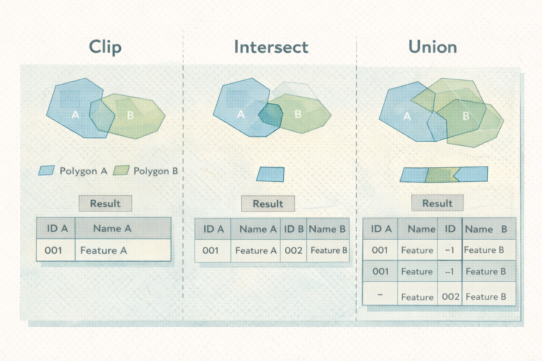
Spatial joins match rows based on geometry relationships—computed on the fly. Which buildings intersect the floodplain? Which parcels are within 500m of a road? The relationship doesn’t live in a column. It exists in space. The database has to compute it for every potential pair.
Here’s where people break things: trying to do a spatial join with an attribute join. You can’t find “parcels near schools” using an attribute column that doesn’t exist. You need a spatial join. Conversely, if you have a zone ID column, use an attribute join, not a spatial operation. It’s orders of magnitude faster.
Spatial joins are computationally expensive because they’re checking geometry relationships. That’s why spatial indexes exist—they let the database eliminate impossible candidates before checking actual geometry. A spatial index on the target table can cut query time dramatically. Always index before spatial joins.
Silent errors happen when your spatial join logic is implicit. “Intersects” means something different than “contains” or “within.” Check your predicate. Wrong predicate gives you wrong features, silently.
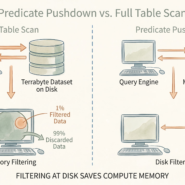
The rule: Relationship in a column? Attribute join. Relationship in space? Spatial join. Index before spatial joins. Filter rows before the join, not after. That cuts compute cost significantly.
Whenever you’re ready, here are 4 ways I can help you grow in GIS & spatial data:
Spatial Lab – My private community where GIS professionals, data engineers, and analysts connect, swap workflows, and build repeatable systems together.
Modern GIS Accelerator – A guided program to help you break out of legacy GIS habits and learn modern, scalable workflows.
Career Compass – A career-focused program designed to help GIS pros navigate the job market, sharpen their pitch, and find roles beyond traditional GIS paths.
Sponsorship: Interested in sponsoring this newsletter (or other content)? Learn more here and fill out the form to get in touch!