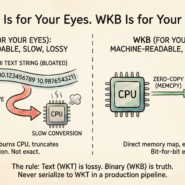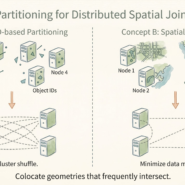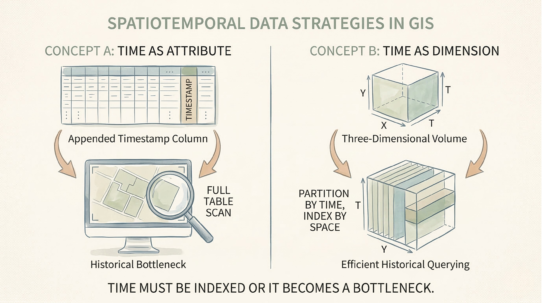



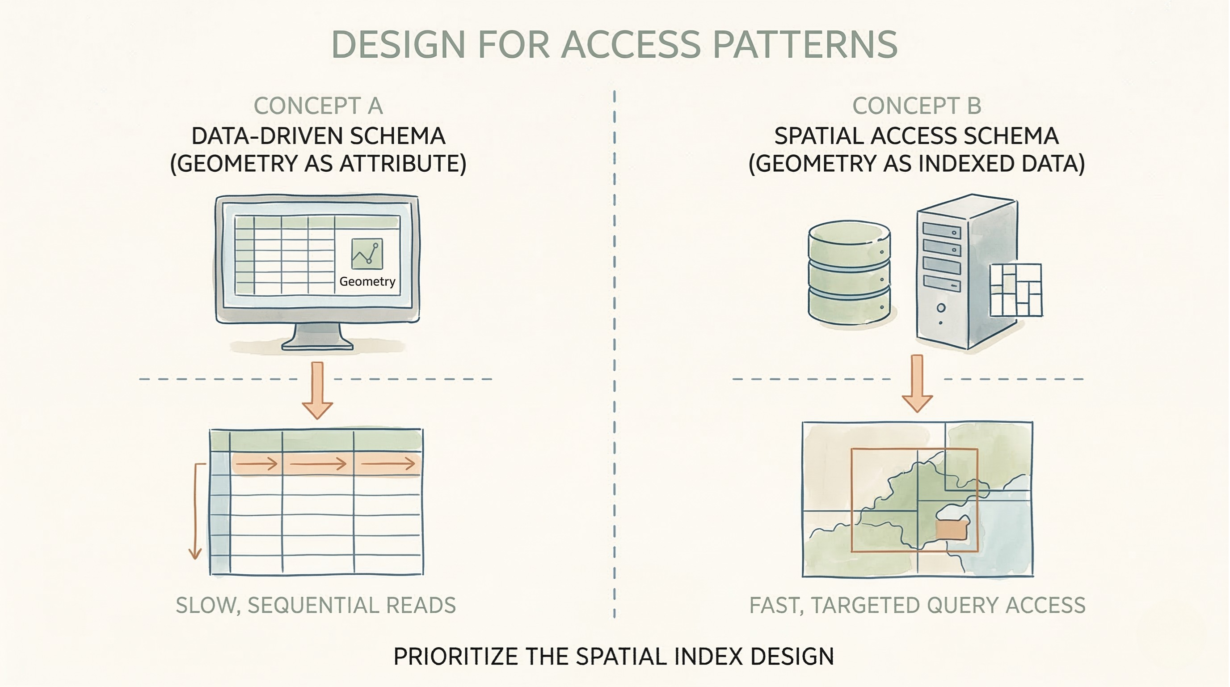

Spatial schemas are not standard relational tables with a geometry column appended. They’re access-pattern-first designs. Get this wrong and no index can save you.
Geometry vs. Geography. Most people pick arbitrarily. GEOMETRY (planar coordinates, fast, assumes flat space) works for local analysis. GEOGRAPHY (spherical, slower, correct at scale) is right for global datasets. Choose based on the scale of queries, not habit.
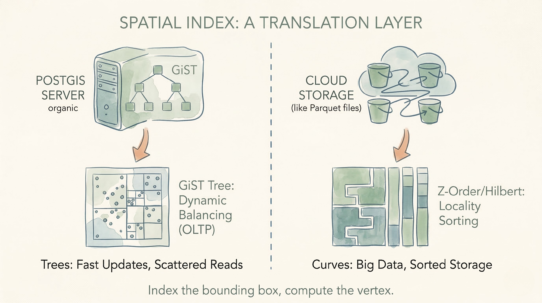
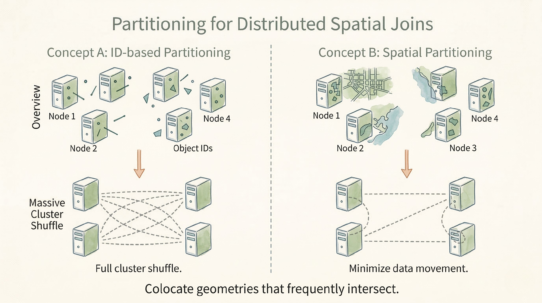
Spatial indexing is prerequisite, not optional. A table without a spatial index will full-table-scan on every query. That’s not a performance problem—that’s a broken design. Build the index before loading data. PostGIS GiST indexes are standard.
Denormalize for spatial joins. Normalization kills spatial performance. A traditional design normalizes properties into separate tables (owner_id → owners table). Spatial systems duplicate that data directly. The spatial join is already expensive. Don’t add a second lookup. Include owner name, phone, and contact info in the feature record alongside geometry.
Separate heavy spatial from frequently updated tabular data. A table with daily attribute updates and expensive spatial indexes creates contention. Split: geometry lives in one immutable table, attributes in another. Join them in queries, not storage.
Materialized views for complex spatial aggregations. If users always ask “show me the union of all zones by district,” precompute it. Spatial unions are expensive. Cache the result.
The rule: Design for the bounding box query first. Index before loading. Denormalize spatial joins. A spatial index is useless if your schema forces full scans.
Whenever you’re ready, here are 4 ways I can help you grow in GIS & spatial data:
Spatial Lab – My private community where GIS professionals, data engineers, and analysts connect, swap workflows, and build repeatable systems together.
Modern GIS Accelerator – A guided program to help you break out of legacy GIS habits and learn modern, scalable workflows.
Career Compass – A career-focused program designed to help GIS pros navigate the job market, sharpen their pitch, and find roles beyond traditional GIS paths.
Sponsorship: Interested in sponsoring this newsletter (or other content)? Learn more here and fill out the form to get in touch!