




Most people think Cloud Optimized GeoTIFFs are a new format. They’re not. It’s the same TIFF standard, reorganized to exploit how HTTP works.
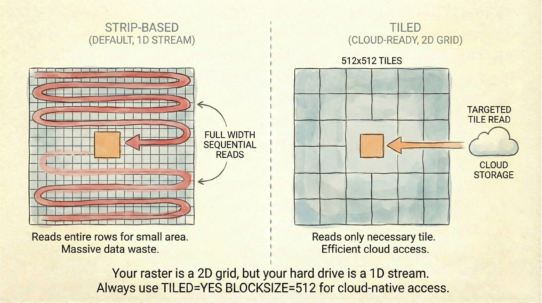
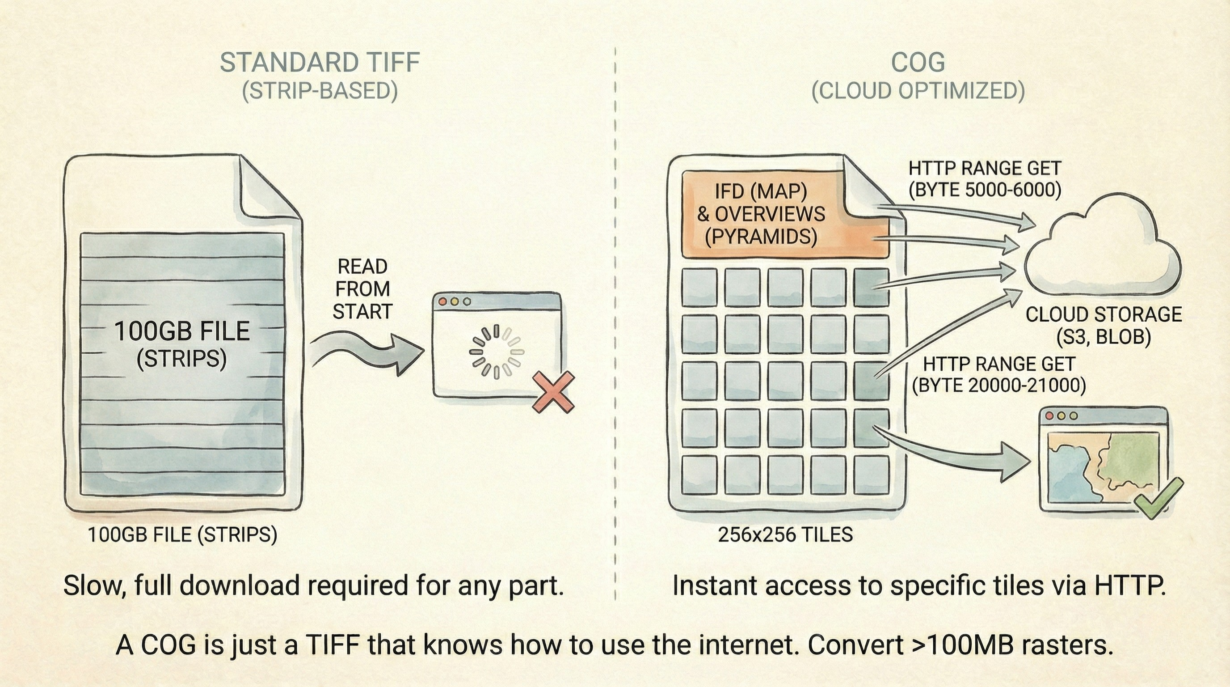
A standard TIFF stores pixels line-by-line (strip-based). To access the bottom-right corner of a large image, you read from the start of the file until you reach that row. A 100GB scene means processing 99.99GB of irrelevant data. A COG reorganizes the same data into internal 256×256 or 512×512 tiles. Now the bottom-right corner is one contiguous chunk you can read independently.
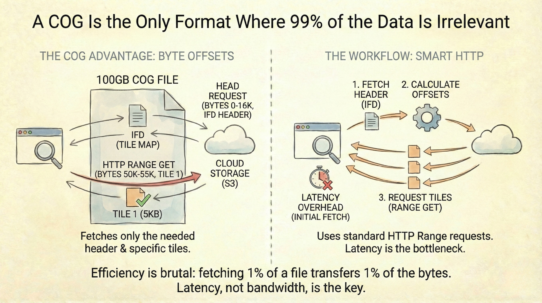
The trick: COGs move the Image File Directory (IFD)—the map of where everything lives—to the start of the file. The client downloads the first few kilobytes, learns the byte offsets of every tile, then requests only those specific bytes using HTTP Range headers. “Give me bytes 5000–6000.” The server sends exactly that. No server-side processing. No full-file download.
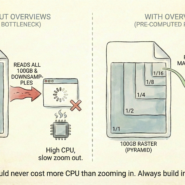
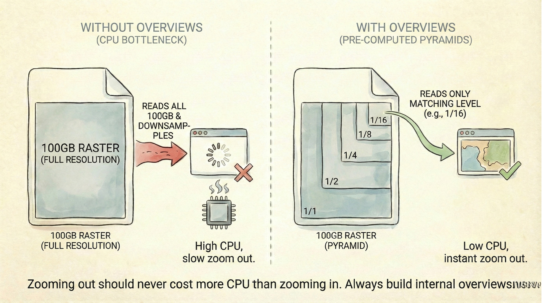
Overviews (image pyramids) are stored in the file header. The client reads metadata, realizes it needs zoom level 2 (coarser resolution), and fetches only those tile bytes. A 100GB satellite scene becomes instantly viewable in a browser.
This works because HTTP was designed for this. GET with a Range header is standard. S3, Azure Blob, and plain web servers all support it.
The rule: Convert rasters >100MB on cloud storage to COG using gdal_translate -of COG input.tif output.tif. Stop building GIS servers to serve static files. Let HTTP do the work. COGs eliminate the bottleneck entirely.
Whenever you’re ready, here are 4 ways I can help you grow in GIS & spatial data:
Spatial Lab – My private community where GIS professionals, data engineers, and analysts connect, swap workflows, and build repeatable systems together.
Modern GIS Accelerator – A guided program to help you break out of legacy GIS habits and learn modern, scalable workflows.
Career Compass – A career-focused program designed to help GIS pros navigate the job market, sharpen their pitch, and find roles beyond traditional GIS paths.
Sponsorship: Interested in sponsoring this newsletter (or other content)? Learn more here and fill out the form to get in touch!